

What is HAIEC
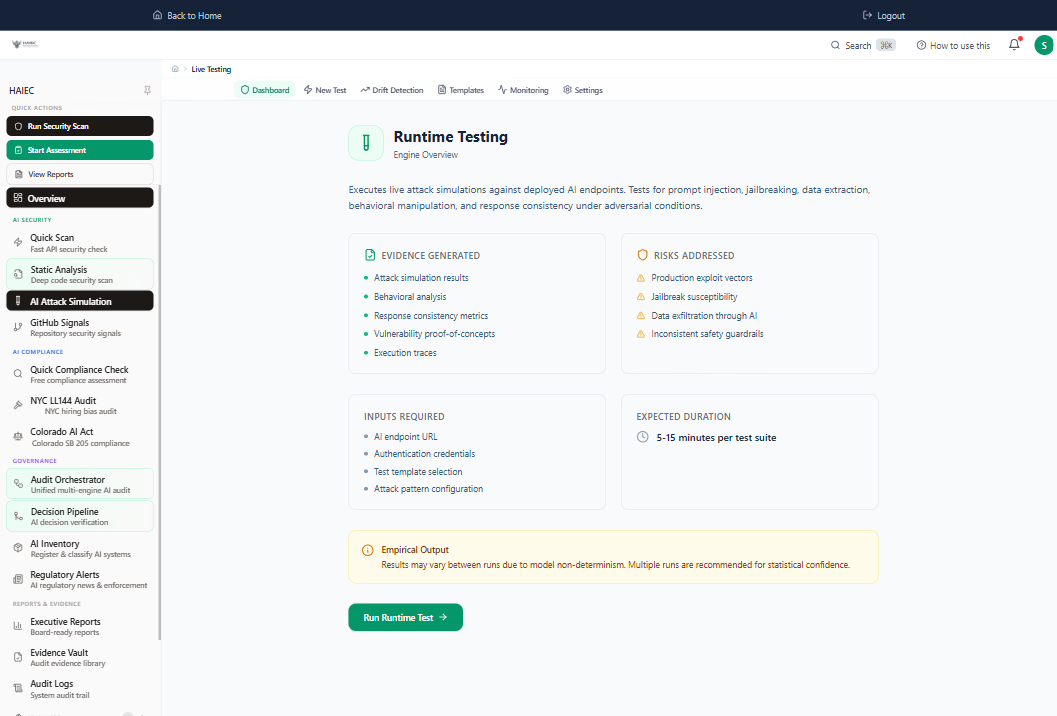
HAIEC helps organizations discover how their AI applications can be manipulated, abused or compromised before attackers, customers or regulators find out. The platform combines three capabilities: Scan the code. HAIEC performs deterministic static analysis of AI applications, agents, RAG pipelines and integrations. It identifies prompt-injection paths, unsafe tool access, RAG poisoning risks, missing authentication, tenant-isolation failures, secret exposure, data leakage, unsafe model outputs and missing rate or cost controls. Attack the live system. HAIEC runs authorized adversarial tests against live AI endpoints to determine how the system behaves under attack. It tests for jailbreaks, system-prompt extraction, instruction override, data exfiltration, tool forcing, goal hijacking, RAG manipulation, multi-turn attacks and resource abuse. Prove the result. Every finding is connected to reproducible test evidence. HAIEC generates tamper-evident audit trails, signed evidence packages and traceable results showing what was tested, what passed, what failed and what must be fixed. HAIEC’s core verdicts are deterministic. It does not rely on another LLM to make subjective judgments about whether an AI system is secure. The same evidence produces the same result. Compliance is built into the evidence layer rather than treated as the starting point. Security findings can be mapped to OWASP, NIST, SOC 2, ISO 27001/42001, the EU AI Act and applicable state or industry requirements when the organization needs them. HAIEC does not simply tell organizations that AI is risky. It scans the system, attacks it safely and produces verifiable proof of whether its controls work.